Hundreds of workers are injured—or worse—each year during equipment servicing simply because proper lockout tagout safety procedures weren’t followed. The machines they trusted to be off weren’t truly de-energized, and the consequences were catastrophic. This isn’t a failure of technology. It’s a breakdown in process, discipline, and understanding.
Lockout tagout (LOTO) is more than a compliance checkbox. It’s a life-saving protocol that, when executed correctly, eliminates accidental energization of machinery during maintenance. Yet, in too many facilities, procedures are outdated, training is inconsistent, or workers take shortcuts. The result? Unnecessary risk.
This guide cuts through the noise. It outlines exactly how lockout tagout safety procedures should be implemented, maintained, and audited across any industrial or commercial environment.
What Are Lockout Tagout Safety Procedures?
Lockout tagout safety procedures are a standardized system used to isolate hazardous energy sources before maintenance, repair, or servicing of machinery and equipment. The goal is simple: prevent accidental startup or release of stored energy—mechanical, electrical, hydraulic, pneumatic, chemical, or thermal—that could cause injury or death.
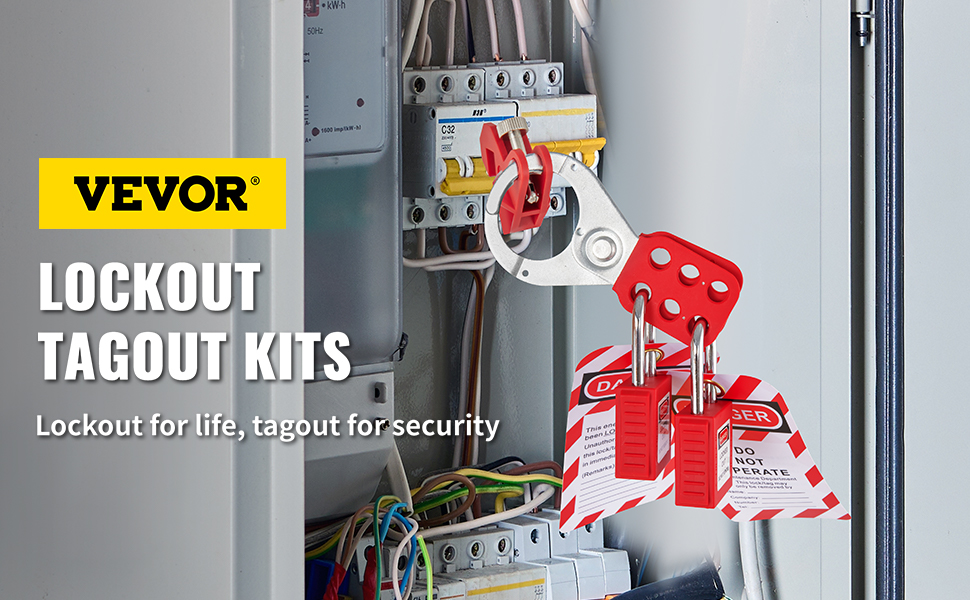
Lockout refers to physically securing an energy-isolating device (like a circuit breaker or valve) with a lock. Tagout involves attaching a warning tag to the same device, indicating that the equipment is not to be operated until the tag is removed. While tagout alone is sometimes permitted under specific conditions, lockout is the preferred and more secure method.
The foundation of LOTO is OSHA’s 29 CFR 1910.147, which mandates that employers implement a written energy control program, train affected employees, and conduct regular inspections. But compliance isn’t just about avoiding fines—it’s about protecting lives.
Example in Practice: A maintenance technician needs to replace a conveyor belt drive motor. Without LOTO, the conveyor could be remotely activated while the motor is disassembled. With proper LOTO, the technician isolates the motor’s power source with a lock, attaches a tag explaining the work in progress, and verifies zero energy before beginning.
The 6 Critical Steps in LOTO Procedures
Effective lockout tagout isn’t guesswork. It follows a strict, repeatable sequence that must be followed every single time.
1. Prepare for Shutdown
Before any work begins, authorized employees must identify all energy sources powering the equipment. This includes primary power (electrical), secondary sources (springs, gravity, capacitors), and stored energy (hydraulic accumulators, elevated loads). A thorough pre-shutdown assessment prevents omissions.
Common Mistake: Skipping auxiliary energy sources. For example, assuming a machine is safe after cutting power, while a pressurized air line remains charged.
2. Notify Affected Personnel All employees who operate or work near the equipment must be informed that a shutdown is imminent. This ensures no one attempts to restart the machine unknowingly.
3. Shut Down the Equipment Use normal stopping procedures—never rely on emergency stops as the primary shutdown method. Follow the equipment’s operational sequence to power down safely.
4. Isolate Energy Sources Close valves, de-energize circuits, block moving parts, and disengage power transmission devices. Apply lockout devices to each energy-isolating point. Each worker involved in the maintenance must apply their own personal lock.
Key Insight: One lock per person. Shared locks create accountability gaps.

5. Control Stored Energy Relieve, disconnect, or block any residual energy. This includes bleeding hydraulic lines, grounding high-voltage circuits, or securing suspended loads. Never assume energy dissipates on its own.
Real-World Scenario: A technician servicing a hydraulic press failed to depressurize the accumulator. When disassembling, the stored pressure caused a sudden, violent release—resulting in crushed fingers.
6. Verify Isolation
This is the most crucial step—and the one most often skipped. Attempt to start the machine using normal operating controls. If it doesn’t activate, and no energy is detected with testing tools (like voltage testers), the equipment is confirmed de-energized.
Workflow Tip: Use a checklist during verification. Document each test performed and by whom.
Who Is Responsible for LOTO Compliance?
Three roles define LOTO accountability:
- Authorized Employees: Those who perform maintenance and apply locks/tags. They must be trained in energy control procedures, understand equipment-specific hazards, and know how to verify isolation.
- Affected Employees: Operators or nearby workers who don’t perform maintenance but need to understand when LOTO is in place and why they must never remove locks or bypass tags.
- Employers: Responsible for creating written LOTO programs, providing training, supplying lockout devices, and conducting annual inspections.
Failure to clearly define these roles leads to confusion. For example, an affected employee might remove a lock thinking the work is complete—triggering a deadly startup.
Common LOTO Violations and How to Avoid Them
Even facilities with LOTO programs often make critical errors. OSHA consistently cites the same recurring violations:
- Failure to conduct periodic inspections: Annual audits are required. Skipping them invalidates compliance.
- Inadequate training: Workers trained only once years ago may forget procedures or not understand updated equipment.
- Using group lockout incorrectly: When multiple workers are involved, a group lockout box must be used. Each worker places their lock on the box, which holds the primary lockout device.
- Assuming equipment is isolated without verification: Never skip the “try to start” test.
- Using damaged or generic locks: LOTO locks should be standardized, durable, and uniquely keyed to individuals.
Practical Example: A plant used standard padlocks for LOTO. During an audit, it was found that several employees shared keys. This broke the personal accountability principle—anyone could remove another’s lock.
Solution: Invest in a dedicated LOTO kit with individually keyed locks, tags, hasps, and lockout stations. Make them easily accessible near high-risk equipment.
Equipment-Specific LOTO Challenges
Not all machines follow the same shutdown logic. Complex or interconnected systems demand customized procedures.
Multi-Energy Machines A CNC machine might use electrical, pneumatic, and hydraulic power. Each source must be isolated separately. A single lock won’t suffice.
Batch Processing Systems In food processing or chemical plants, lines often span multiple zones. LOTO must cover all upstream and downstream sections that could energize the work area.
Portable Equipment Hand-held grinders or drills are often overlooked. But if they’re being repaired or blade-changed, they require LOTO-like procedures—even if battery-powered.
Workflow Tip: Develop machine-specific LOTO checklists. Post them near control panels. Include diagrams showing all isolation points.
Implementing a LOTO Program: What Works
A successful LOTO program isn’t built overnight. It requires planning, documentation, and cultural reinforcement.
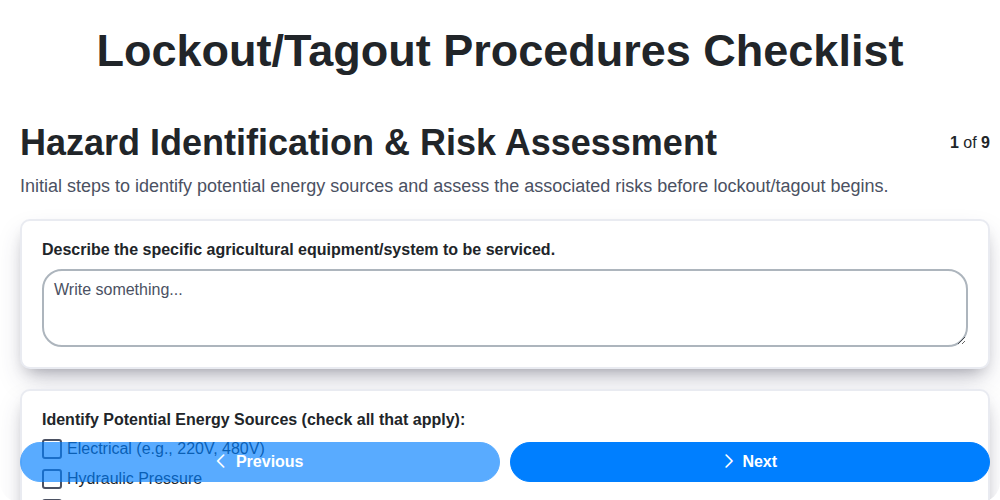
Step 1: Conduct an Energy Audit Walk through every machine. Map all energy sources and isolation points. Use photos or schematics.

Step 2: Write Clear Procedures Document each step for every piece of equipment. Include: - Equipment ID - Energy sources - Isolation methods - Verification steps - Required tools
Step 3: Train and Retrain Initial training isn’t enough. Conduct refreshers annually or when procedures change. Use hands-on drills—simulate a lockout scenario.
Step 4: Audit Regularly Assign a supervisor to observe a LOTO procedure quarterly. Use a checklist to verify compliance. Document findings and correct gaps.
Step 5: Enforce Accountability No one—regardless of rank—should bypass LOTO. Leadership must model compliance. Celebrate safe behavior, not speed.
Essential LOTO Tools and Devices
The right equipment ensures consistency and durability in lockout applications. Here are five industry-standard tools every facility should have:
| Tool | Purpose | Best Use Case |
|---|---|---|
| Personal Safety Locks | Durable, uniquely keyed locks | Individual worker accountability |
| Lockout Hasps | Allows multiple locks on one isolation point | Group maintenance work |
| Valve Lockouts | Secures gate, ball, and butterfly valves | Pneumatic or hydraulic systems |
| Circuit Breaker Lockouts | Prevents re-energizing of breakers | Electrical panels |
| LOTO Stations | Centralized storage for locks, tags, and devices | High-traffic maintenance zones |
Pro Tip: Use color-coded locks by department or shift to improve visibility and tracking.
The Human Factor: Why LOTO Fails
Technology and checklists don’t fail—people do. Complacency, time pressure, and normalization of deviance erode even the best LOTO systems.
A technician might think, “I’m just clearing a jam. It’ll take 30 seconds.” So they skip lockout. That mindset causes over 50% of LOTO-related injuries.
Combat this with: - Peer accountability—encourage workers to call out unsafe behavior - Leadership presence—managers should participate in audits - Near-miss reporting—create a no-penalty system for reporting LOTO close calls
Culture eats compliance for breakfast. Build a culture where safety isn’t questioned.
Final Steps to a Bulletproof LOTO System
Lockout tagout safety procedures aren’t a one-time project. They’re a continuous commitment to zero energy during maintenance. Start by auditing your current process. Are written procedures up to date? Are locks available and in good condition? Are employees trained—not just certified, but competent?
Then, standardize. Create equipment-specific checklists. Install lockout stations. Conduct surprise audits. Reward compliance.
Most importantly, treat every maintenance event as high-risk. Because it is.
Protect your team with discipline, clarity, and relentless attention to detail. That’s not just compliance. That’s leadership.
FAQ
What is the difference between lockout and tagout? Lockout uses a physical lock to prevent equipment activation, while tagout uses a warning tag. Lockout is more secure and preferred when possible.
Who needs LOTO training? Authorized employees (performing maintenance) and affected employees (operating equipment) both require training, though the depth differs.
How often should LOTO procedures be inspected? OSHA requires annual inspections for each machine-specific procedure, conducted by an authorized employee not involved in the review.
Can tagout be used without lockout? Yes, but only if the tag provides equivalent protection and the facility follows strict supplemental measures like continuous supervision.
What should a LOTO tag include? Name of the authorized employee, date, reason for lockout, and contact information.
Do battery-powered tools require LOTO? Yes, when being repaired or serviced. The battery must be removed and the device locked out to prevent accidental activation.
What happens if a worker forgets their lock? The lock should only be removed under a formal policy, typically involving a supervisor, verification that the worker is clear of danger, and documented approval.
FAQ
What should you look for in Lockout Tagout Safety Procedures: A Complete Guide? Focus on relevance, practical value, and how well the solution matches real user intent.
Is Lockout Tagout Safety Procedures: A Complete Guide suitable for beginners? That depends on the workflow, but a clear step-by-step approach usually makes it easier to start.
How do you compare options around Lockout Tagout Safety Procedures: A Complete Guide? Compare features, trust signals, limitations, pricing, and ease of implementation.
What mistakes should you avoid? Avoid generic choices, weak validation, and decisions based only on marketing claims.
What is the next best step? Shortlist the most relevant options, validate them quickly, and refine from real-world results.